Greater responsibility for the whole value chain
The requirement to assess the entire value chain is one of the biggest differences compared with previous rules.
CSRD and ESRS
The CSRD is the EU directive on sustainability reporting. Here we explain what it means, who is in scope and how Centuri supports your work with materiality assessments, risks and follow-up, standard by standard.
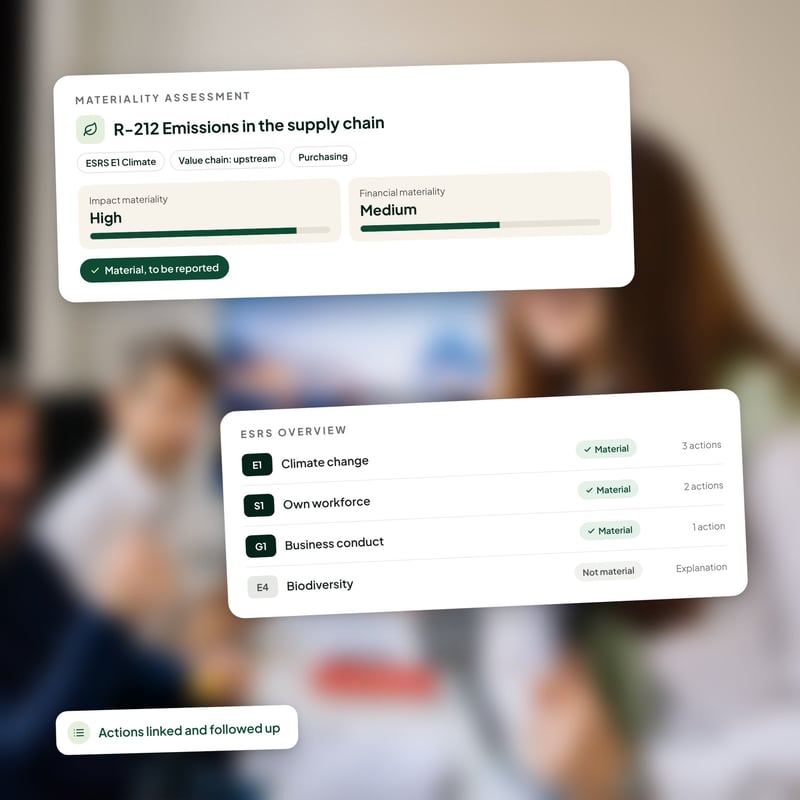
The CSRD (Corporate Sustainability Reporting Directive) is an EU directive that requires companies to report on the impact of their social and environmental activities. Its purpose is to ensure transparency and comparability in sustainability reporting, and to help the EU reach its goal of net-zero emissions by 2050.
The directive is supported by the ESRS (European Sustainability Reporting Standards), a common standard for sustainability reporting. Put simply, the CSRD sets out what sustainability information companies in scope must report, while the ESRS describe how to report it.
The requirement to assess the entire value chain is one of the biggest differences compared with previous rules.
Stakeholder engagement is a central part of the materiality assessment and key to understanding material risks and opportunities.
A sustainability matter is material when it meets the criteria for impact materiality, financial materiality or both.
The ESRS specify which disclosures must be made and how, and a brief explanation is required for matters that are not material.
The EU has simplified the CSRD through Omnibus I (Directive 2026/470), which entered into force on 18 March 2026. The requirements now apply to companies with at least 1,000 employees and net turnover of at least EUR 450 million. Companies below these thresholds do not need to report for financial years starting in 2027 or later.
Even if you are not directly in scope, the requirements can still reach you. Larger customers and partners need information from across their value chain, and many companies choose to report voluntarily. With structured sustainability work in place, it is easier to respond when the questions come.
Last updated: 25 October 2026
Centuri as your solution
Centuri helps you make sustainability a living part of your business.
You model stakeholder mapping and requirements in process mapping, and link them to processes, policy documents and instructions. Ready-made templates and development processes secure management commitment, and a ready-made information structure makes information easier to find.
With risk management in Centuri, you carry out a complete materiality assessment, link actions and follow up the results. You can categorise risks by ESRS standard, position in the value chain, process and geography, and assess them for both impact materiality and financial materiality.
Centuri's automated workflows give you operational support for every type of non-conformance, along with internal checks and follow-up. All to build an organisation that improves continuously.
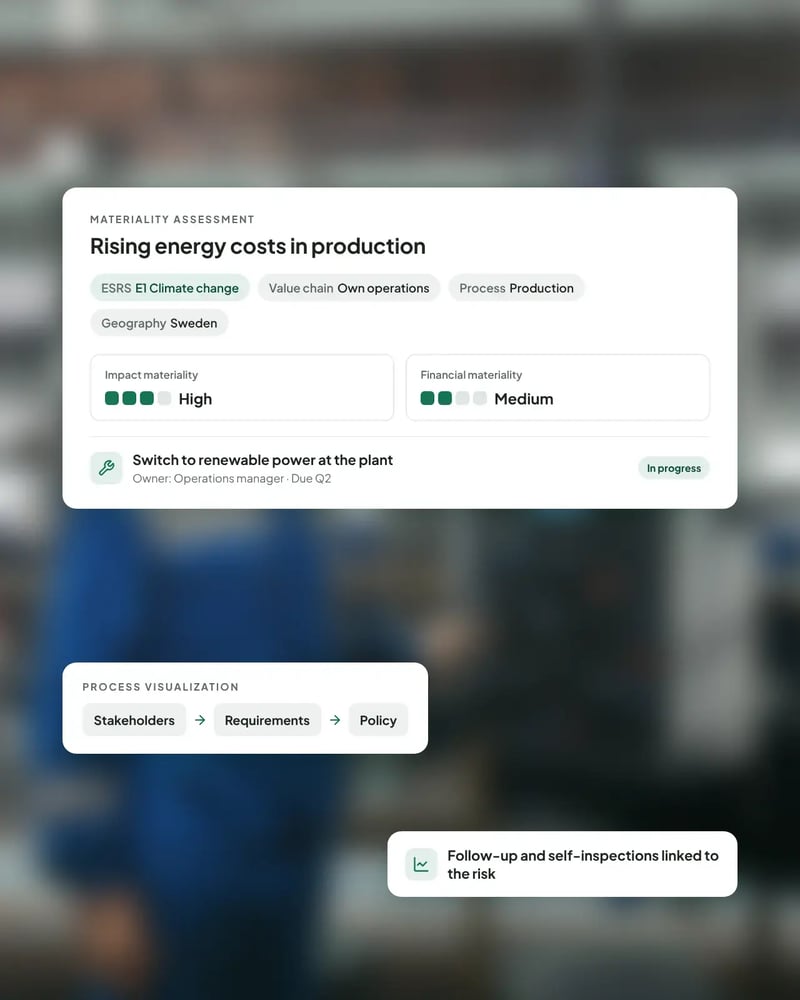
Describes the structure of the standards, explains drafting conventions and fundamental concepts, and sets out general requirements for reporting.
How Centuri helps: Tailored templates and issuing processes ensure that reporting is consistent and involves all relevant stakeholders. The materiality assessment can be categorised by every relevant parameter and linked to actions and non-conformance reporting.
Sets out disclosure requirements at an overarching level for all material sustainability matters, focusing on governance, strategy, impacts, risks and opportunities, and metrics and targets.
How Centuri helps: Process mapping linked to stakeholders, requirements and goals gives you a clearer picture of how your organisation fits together. Strategic plans, risks and opportunities are made visible, linked to actions and followed up continuously.
Covers corporate culture, protection of whistleblowers, animal welfare, political engagement and lobbying, relationships with suppliers (including payment practices), and corruption and bribery.
How Centuri helps: Centuri supports policy documents and procedures, and helps you operationally with, for example, supplier assessments, non-conformance reporting and whistleblower case handling.
Covers, for example, climate change adaptation, climate change mitigation and energy.
How Centuri helps: Map climate risks with risk management. With case management, you add action programmes and set up internal checks and internal reporting for follow-up. Data is visualised with ready-made report templates.
Covers, for example, pollution of air, water and soil, pollution of living organisms and food resources, substances of concern and microplastics.
How Centuri helps: Map risks and link actions. With non-conformance management, you link reported non-conformances directly to the risks, identify trends and reprioritise your efforts. Serious non-conformances can be escalated directly to management or the board.
Covers, for example, water consumption, water withdrawals, water discharges and the extraction and use of marine resources.
How Centuri helps: Reported data is visualised with ready-made report templates and can be categorised by geography, process and more.
Covers the drivers of biodiversity loss, impacts on the state of species and on the extent and condition of ecosystems, and dependencies on ecosystem services.
How Centuri helps: Policies, transition plans, action programmes with impact and risk assessments, non-conformances and follow-up against targets. Centuri helps you with the whole picture.
Covers, for example, resource inflows, resource outflows related to products and services, and waste.
How Centuri helps: Policies and plans, impact analyses, actions and results documents based on predefined templates. Reported data is compiled with ready-made report templates.
Covers working conditions, equal treatment and other work-related rights for your own employees.
How Centuri helps: In addition to policies, procedures and templates, Centuri handles risk assessments, incident and injury reporting, work environment non-conformances, rehabilitation cases and complaints. With training management, you ensure skills development and qualifications.
Covers the same topics as ESRS S1, but for workers in the value chain.
How Centuri helps: Policies, a way for workers in the value chain to report complaints, internal checks and consolidated reports on working conditions.
Covers communities' economic, social and cultural rights, civil and political rights, and the rights of indigenous peoples.
How Centuri helps: Mapping of stakeholders and requirements, risk mapping and actions to manage impacts on affected communities, plus policies and procedures for working with them.
Covers information-related impacts, personal safety and social inclusion for consumers and end-users.
How Centuri helps: Mapping of stakeholders and requirements, proactive risk mapping with corrective and preventive actions, policies and procedures, customer information, and handling of customer complaints and returns.
The CSRD is the EU directive that sets out what sustainability information companies in scope must report. The ESRS are the standards that describe how to report it.
A sustainability matter is material if it meets the criteria for impact materiality, meaning the company's impact on people and the environment, or financial materiality, meaning how the matter affects the company's finances, or both. Material matters are reported under the relevant ESRS.
Following Omnibus I, the CSRD applies to companies with at least 1,000 employees and net turnover of at least EUR 450 million. Companies below the thresholds may still receive questions from larger customers in their value chain, and can choose to report voluntarily.
Book a 30-minute demo and we'll show you how to work with materiality assessments, risks and follow-up in Centuri.
1. Book a time. Choose a time that suits you. The demo takes 30 minutes.
2. See Centuri for your needs. We show you the parts of the platform that meet your needs.
3. Get a proposal. You receive pricing and a plan for getting started. Initial implementation takes 4–8 weeks.